
How to Simply Identify Coin Finish Types: Proof, Business Strike, SMS, Matte, and Polished Dies
Many collectors use a coin scanner app almost every day. It helps identify a coin’s country, year, type, and typical price range. It speeds up sorting and turns a mixed pile into a clear list of entries. One important question remains, though. Can any app tell you what finish your coin has? And why does the finish matter at all?
Finish type affects how a coin looks, how it is used, and how the market values it. Proof, business strike, SMS, matte, and coins from polished dies can look similar at first glance. In practice, they are made differently and behave differently under light. This article explains how to distinguish these finish types using simple visual checks and structured comparison.
Why Finish Types Matter
Finish is not decoration. It documents the production method behind each coin. Collectors study finish types because they help verify authenticity, understand mintage practices, and detect unusual die states. Two coins from the same year may look different due to changes in die condition, polishing stages, or the use of special preparation techniques.
Finish recognition also plays a role in value. A proof coin commands a premium because of its preparation. An SMS coin stands out because the series was short-lived. A polished-die piece gives insight into the first stage of die wear. Understanding these distinctions forms a core skillset for anyone who wants to evaluate coins accurately without relying on assumptions.
Proof Finish
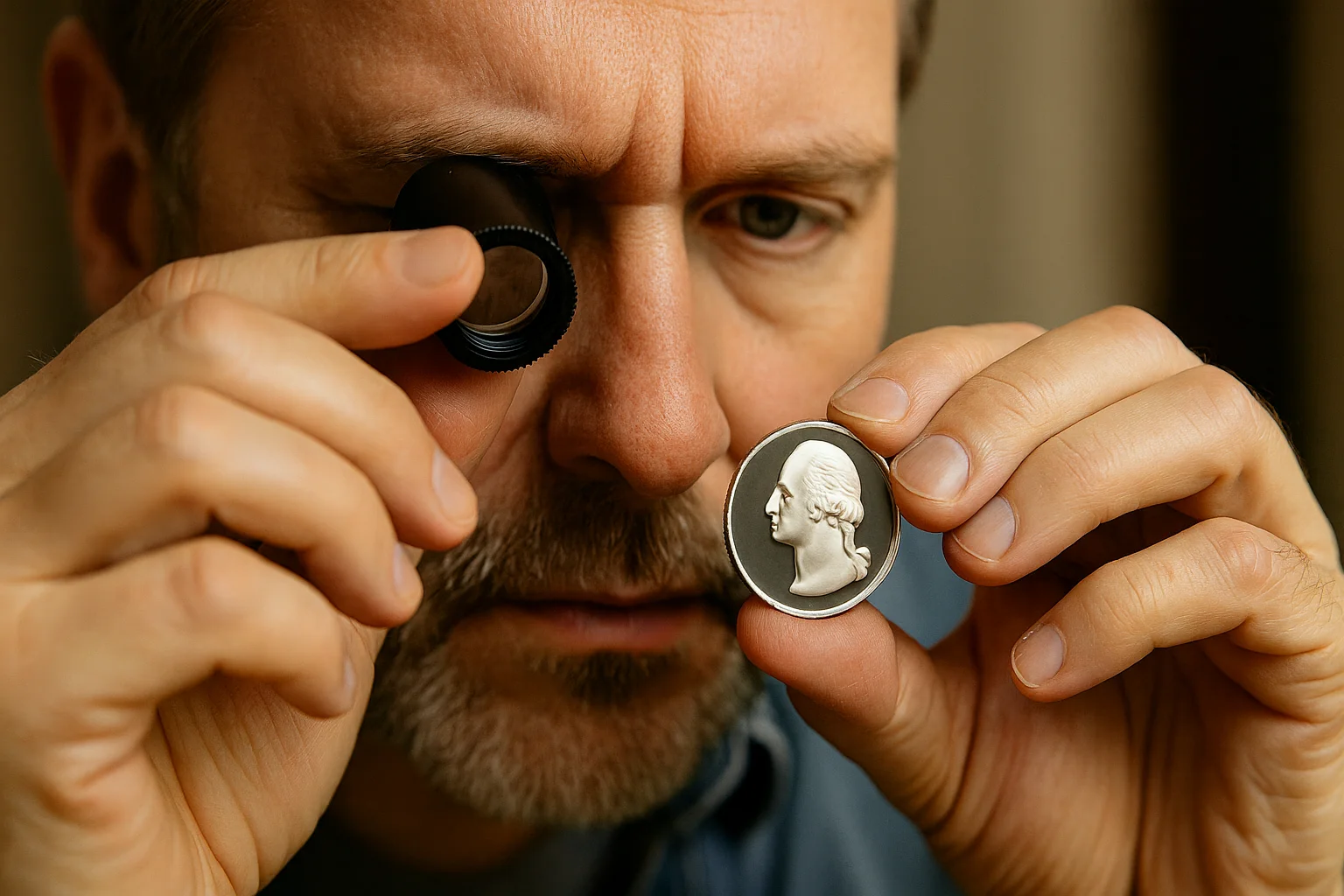
Proof coins follow a dedicated production process. Dies are polished before use, planchets are specially cleaned, and each strike applies higher pressure than normal circulation pieces. The result is a coin with mirrored fields and frosted design elements. Many modern proofs display a strong contrast known as “cameo.”
A proof is easy to confirm once you know what to look for. The strike is sharp, edges are crisp, and fine details stand out even without magnification. The coin has no contact marks from circulation because proofs are not released into daily use.
A comparison table helps clarify the main proof markers:
| Feature | Appearance |
| Fields | Mirror-like reflection |
| Devices | Frosted or matte surfaces |
| Strike | Very sharp and uniform |
| Edge | Clean, squared rim |
| Contact marks | Minimal, often none |
Proof coins teach collectors how high-pressure striking and die preparation influence appearance. When a proof is weak or uneven, it often signals die fatigue or polishing inconsistencies, which become important for understanding production quality.
Business Strike Finish
Business strike (or regular strike) coins are made for everyday use. The mint produces them at high speed with minimal extra preparation. Dies are not polished to mirror level. Blanks receive less handling.
Typical appearance:
- Fields show normal mint luster, not a deep mirror.
- Light reflects in a cartwheel pattern, especially on new coins.
- Small marks and contact traces appear easily because of bulk handling.
- Relief is clear but often not as sharp as on proof coins.
A brilliant uncirculated business strike can look impressive. It may have a strong cartwheel and clean fields. This still differs from proof: the reflection will be more diffuse and less deep.
Key checks:
- Hold the coin under a small light source and tilt it.
- Ask if you see a mirror or a spread-out luster pattern.
- Compare the coin with a known proof of a similar date, if possible.
Business strikes form the backbone of most collections and variety searches. Knowing their typical surface helps you detect when something stands out.
SMS Finish
Special Mint Set (SMS) coins were issued for 1965, 1966, and 1967 as a replacement for proof sets. They do not share full proof mirror fields, but they also are not standard business strikes. Their finish sits between these two types.
Visual traits of SMS coins:
- Better strike quality than regular circulation coins from the same years.
- Sharper details on devices and lettering.
- Fields often show a smooth, satiny, or semi-gloss appearance.
- No deep mirror reflectivity like in a proof.
Identifying SMS coins can be tricky when they are removed from their original packaging. Here, modern tools help with context. The best coin identifier app for iPhone can confirm the year and basic issue type, and remind you that those three years had SMS sets. It can show that a coin comes from a period when both regular strikes and SMS pieces existed.
Even then, the finish must be judged with the eye. SMS surfaces look more refined than typical business strikes, but they will not give a clear mirror. Compare a suspected SMS coin with a normal circulation coin from the same year. The SMS piece should show cleaner surfaces, better detail, and a more even, satiny sheen.
Matte Proof Finish
Matte finishes appear less often but matter for specific series. In a matte finish, the mint creates a non-reflective surface by sandblasting dies or treating them to reduce shine. The goal is a uniform, granular texture.
Main characteristics:
- Almost no luster. The surface looks dry or velvety.
- Fine-grained visible under magnification.
- Relief remains sharp if the coin is in good condition.
- No mirror areas, even under strong light.
Historic examples include early 20th-century matte proof Lincoln cents and some commemorative issues. Modern mints also use matte-style finishes on certain special coins and medals.
Main confusion:
- Collectors sometimes mistake heavy wear for a matte finish.
- A worn business strike can lose shine and imitate a flat surface.
- Real matte pieces preserve detail even where the surface looks dull.
A good test is to look at the highest points of the design. On worn circulation coins, those points look soft or flattened. On true matte finish coins in decent grade, the edges of letters and devices stay crisp despite the lack of shine.
Polished Die Finish
Sometimes the mint polishes working dies used for regular strikes. This may happen to restore life to a die or to clean it. The result can be coins with brighter surfaces than typical business strikes, especially early in the die’s life. These coins are not proof and were not prepared as collector strikes, yet they can look proof-like.
How they appear:
- Strong, even luster on the fields.
- Light may seem more concentrated, but the reflection stays softer than a mirror.
- Relief often shows normal texture, not the clear frost of proof coins.
- Minor lines from polishing may be visible in the fields.
Polished-die strikes are easy to misinterpret. Collectors may think they found a proof or a special issue. A coin scanner app for Android can confirm the normal circulation type and year, and help record the coin in your notes. Finish still needs direct inspection.
Ask simple questions:
- Does the field behave like glass, reflecting objects clearly?
- Or does it just shine strongly without a sharp mirror?
- Does the coin come from a year and a mint that issued proofs separately?
Polished dies create attractive coins, but do not automatically raise them to proof status.
How to Compare Finishes Side by Side
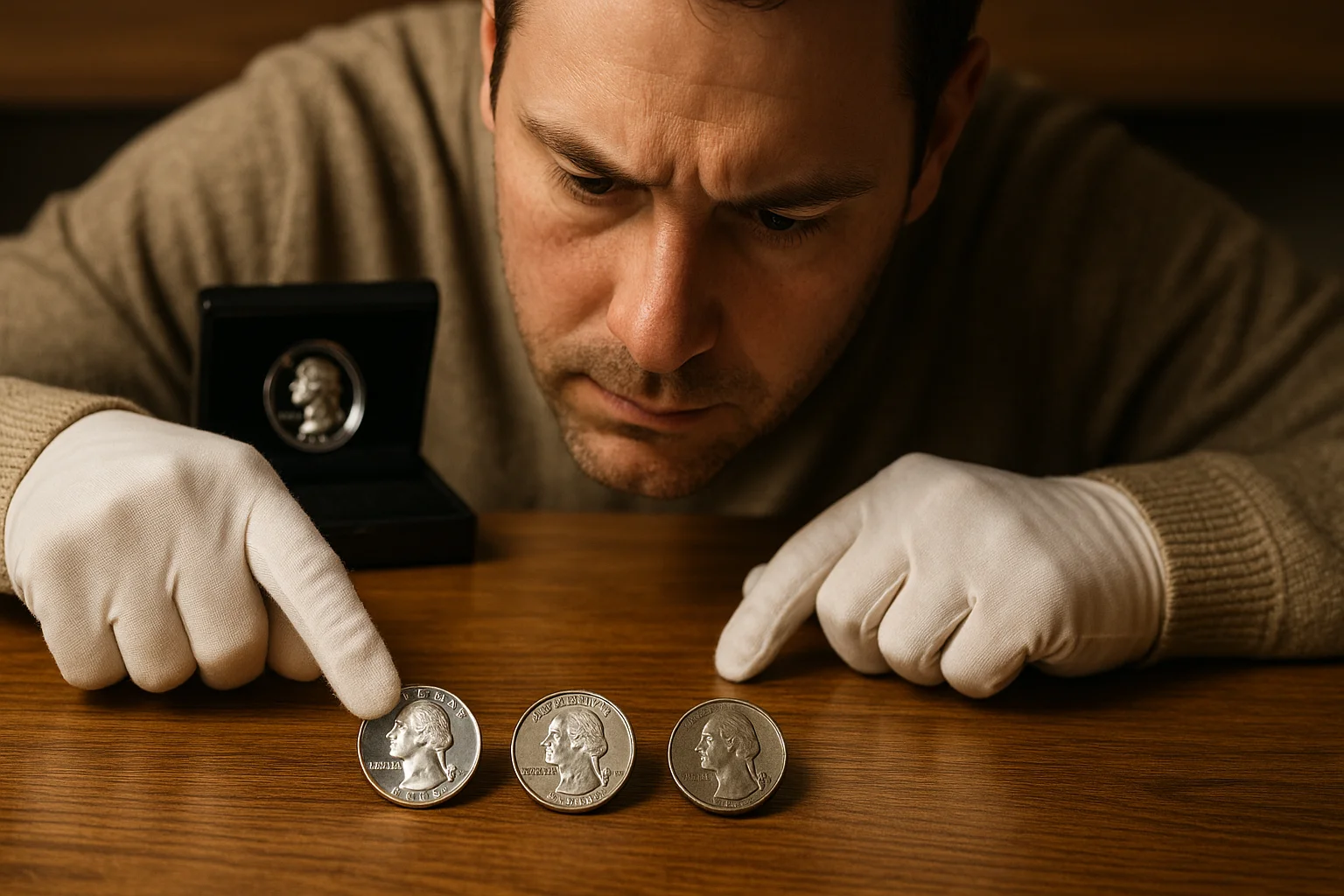
Direct comparison teaches finish recognition faster than isolated inspection. Collectors place two or three coins under the same light and look for differences in field reflection, device texture, and strike clarity. The goal is to train the eye to detect contrasts rather than memorize fixed definitions.
A simple method uses three positions: straight-on, slight tilt, and full rotation. Mirror fields react strongly to angle changes, while satin or matte surfaces stay constant. Polished-die fields brighten but lack depth. Business strikes show soft, diffuse reflections.
A short checklist keeps the process easy:
- Check fields first, not design.
- Compare edges for rim shape.
- Evaluate strike depth across letters and portrait.
- Observe how light moves across the surface.
These steps turn finish recognition into a reliable skill.
Frequent Misidentifications and How to Avoid Them
Many finish errors follow repeating patterns. Collectors often misread shine, texture, or die state when evaluating coins, especially if they rely on brightness alone. New business strikes can look proof-like, worn coins may appear “matte,” and early polished-die pieces often imitate premium surfaces.
Confusion also appears when sets contain more than one finish type, as SMS and special uncirculated coins do not match proof characteristics. The table below summarizes common mix-ups and the correct way to avoid them:
| Misidentification | Why It Happens | How to Avoid It |
| Bright surface mistaken for proof | Fresh business strikes or polished dies create a strong shine | Study the fields: proofs have mirror depth, not simple brightness |
| Worn coin mistaken for matte | Loss of luster softens all details | Check texture under magnification; true matte has uniform grain |
| Assuming any set coin is proof | Sets often include SMS or special uncirculated strikes | Confirm which finishes were issued for that year and mint |
| Polished-die strike mistaken for premium finish | Early dies create smooth fields | Compare devices: polished dies still show standard relief |
| Judging the finish only by overall brightness | Light hides true texture | Observe from several angles and compare with another coin |
Finish recognition improves with steady practice. Handling multiple examples from the same year and mint sharpens observation and prevents most misinterpretations.
Final Thoughts
Finish types reveal how each coin came off the press and what the mint was trying to achieve in that moment. Once you learn to read surfaces, sharp strikes, and rim structure, these differences become clear. The process is straightforward: look closely, compare examples, and pay attention to how light reacts on the fields and devices.
Digital tools, for example, the Coin ID Scanner app, help you stay organized, but the final identification always comes from a personal observation. With steady practice, the patterns repeat, the eye adapts, and the distinctions become easier to spot. Thus, this skill adds confidence to your decisions.